Your Instructor Saw It in Lesson Two: The Small Habits That Predict Whether You'll Pass
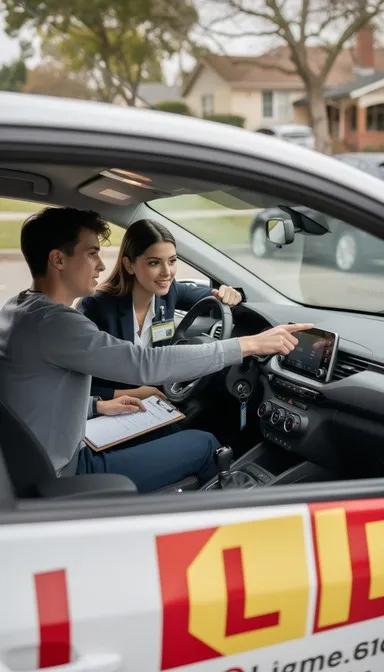
Photo: driving instructor teaching student driver inside car, via images.stockcake.com
Ask any driving instructor and they'll tell you the same thing: they usually know within two or three lessons which students will pass the road test on the first try. Not because they're psychic. Because the test isn't really testing what people think it's testing.
The examiner doesn't care that you can park on the third attempt. They care about what you do by default — the stuff you do when your brain is busy. And your instructor has been watching your defaults since day one. Here's what they're noticing, whether they say it out loud or not.
1. Whether You Check Mirrors Like You Mean It
There's mirror-checking-as-theater: a quick eye flick performed because you know someone's watching. Then there's actual mirror use — a rhythm, roughly every five to eight seconds, that keeps a running movie of the traffic around you playing in your head. Instructors can tell the difference instantly, and so can examiners. The fix: make mirrors part of your speed changes. Every time the car slows, speeds up, or turns, your eyes go to glass first. That's the habit that sticks.
2. Where Your Hands Wander
Left hand at 9 o'clock, right hand resting or on the wheel — fine. One hand at 12, elbow on the door, other hand holding a phone that "isn't being used" — your instructor has already written a small essay about it. Beyond the airbag-safety reasons, hand position is a proxy for attention. Sloppy hands usually mean a sloppy brain. If you can't keep your hands honest for a 40-minute lesson, the test examiner will notice in ten.
3. How You Take a Correction
This is the big one, and it's not about driving at all. When the instructor says "you were a little close to that curb," do you:
- (a) say "okay" and adjust,
- (b) argue that the curb was basically a suggestion, or
- (c) spiral into 90 seconds of self-criticism while drifting out of your lane?
Option (a) students pass. Not because they're naturally gifted, but because they metabolize feedback in real time. Roads are a nonstop feedback machine — honks, brake lights, weather — and drivers who can't process correction quickly become dangerous quickly. Instructors know this. So yes, they're judging your reaction to being judged. It's the most relevant thing they can measure.
4. Whether You Blame the Car, the Light, or "That Guy"
"The brake pedal sticks." "That light changed too fast." "Nobody uses turn signals in this town." Occasionally these are true. When they're every lesson, your instructor files you under a different category: the driver who will never learn, because nothing is ever their fault. Passing a road test requires owning your mistakes in the moment. So does surviving 30 years of commuting.
5. Your Speed When Nobody's Watching
Instructors love checking your speedometer on empty residential streets. Do you hold the limit because it's the limit, or does the car drift up to 35 the second the road looks forgiving? Speed discipline in low-stakes moments is one of the strongest predictors of test-day performance — and of whether you'll get a ticket in year two.
6. How You Handle the Unexpected Cyclist
You're mid-instruction, thinking about your turn, and a kid on a bike appears from between parked cars. What happens next — smooth brake, mirror glance, space given — or a startled swerve? Instructors build these moments into lessons on purpose, because examiners build them into tests on purpose, and life builds them in constantly with zero warning. Reacting calmly to surprises is a trained skill, not a talent. Practice being startled quietly.
7. Whether You're Driving or Just Steering
The final tell. Some students operate the car; others actually drive — scanning intersections before they enter them, covering the brake near parked cars, leaving a following distance that doesn't require faith. It's the difference between passing a test and becoming a driver. Instructors can feel it through the car itself.
Why the Nagging Is a Gift
Every one of these habits shows up on your road test scoring sheet in some form — observation, vehicle control, speed management, right-of-way. The corrections that feel repetitive in lesson three are the exact checklist items an examiner marks in pen. So the next time your instructor sighs about your mirrors, take it as insider information: they're telling you where the points are hiding. Absorb it, adjust, and let them judge away. It's the cheapest coaching you'll ever get.