Your License Is Three Weeks Old and You're About to Drive Strangers for Money
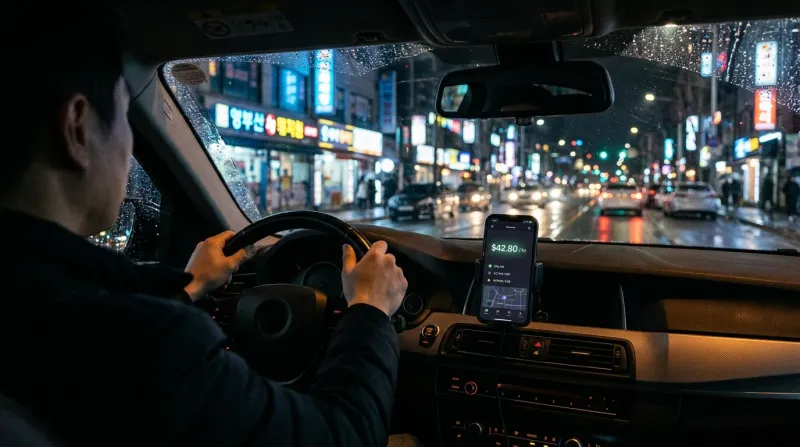
Photo: rideshare driver night city traffic smartphone mount, via mystrodriver.com
Here's a scenario that happens thousands of times a week in America: someone passes their road test, gets a license that's still warm from the DMV printer, downloads an app, and within a few weeks is picking up strangers at 2 a.m. outside a bar for money.
If you're one of those drivers, nobody's going to stop you. Rideshare platforms require a license, insurance, a car that meets age standards, and a background check. What they don't require is any proof that you can actually handle the job. The road test you passed measures the bare minimum — and the bare minimum was designed for getting to the grocery store, not for eight-hour shifts in unfamiliar traffic.
What the Road Test Never Asks Of You
Think about what your exam actually covered. A parallel park, a lane change or two, maybe a three-point turn, all in daylight, all in a car you'd practiced in, all while an examiner stayed quiet in the passenger seat.
Now think about a Friday night shift. You're navigating to an address you've never seen while a passenger chats at you. You've been driving for five hours and your eyes are tired. Someone jaywalks between parked cars. You need to merge onto a highway ramp you've used twice in your life. None of that shows up on a scoring sheet.
Professional drivers — the ones who do this as a career — build skills in three areas that new gig drivers almost never train for:
- Defensive positioning. Pros constantly place the car where they have options: escape lanes, buffer space, sightlines past the vehicle ahead. New drivers tend to follow at whatever distance feels normal, which is usually too close.
- Fatigue management. There's a reason commercial truckers have hours-of-service rules. Microsleeps and slowed reaction times creep in long before you feel sleepy, and rideshare shifts run exactly when your body wants to wind down.
- Passenger awareness. You're now responsible for people entering and exiting your car at curbs, in traffic lanes, and in dim parking lots. That's a skill set — door-side positioning, pull-over placement, reading the environment — that no personal driving experience teaches.
The Skills Gap Is Real, and It's Measurable
Insurance data and crash research consistently show that crash risk is highest in a driver's first months of independent driving. Layer on unfamiliar roads, night hours, distraction from app notifications and passenger conversation, and financial pressure to accept one more ride — and you've built a job description that would flunk a safety audit anywhere else.
At our driving school, we've long argued that learning to drive is a curriculum, not an event. Gig platforms effectively treat it as an event: you passed, congratulations, here's a phone mount. The gap between those two philosophies is where a lot of avoidable fender-benders — and worse — happen.
Your Four-Week Self-Training Roadmap
If you're set on driving for income, treat your first month like onboarding, because nobody else will. Here's a practical sequence:
Week 1: Log solo miles in the conditions you'll actually work in. Before your first passenger, drive at night, in rain, and on highways near your service area. No app, no pressure. You're building a mental map of the streets you'll be dispatched to.
Week 2: Practice the job's weird specifics. Pull over to a curb smoothly and legally, twenty times, in different spots. Practice airport and venue pickups. Get comfortable with your phone mount placement so glances take under a second.
Week 3: Build your fatigue rules and write them down. Decide your hard limits now — a maximum shift length, a mandatory break every two hours, a no-driving line you won't cross when tired. Fatigue decisions made at 3 a.m. are bad decisions. Make them at your kitchen table instead.
Week 4: Do a professional tune-up. One or two lessons with an instructor, explicitly framed as professional development, will surface habits you can't see yourself. Ask specifically about defensive positioning and night driving. It's the cheapest insurance you'll ever buy.
Driving for Money Changes the Job
The moment a passenger climbs in, you're no longer just a driver — you're a small business with wheels, and your skill is the product. Platforms won't hand you that mindset; you have to bring it yourself.
There's nothing wrong with gig driving as a first job behind the wheel. There's something wrong with pretending it's the same as driving yourself to class. Close the gap on purpose, and those first paid weeks become the foundation of genuinely good driving — not just the start of a habit you'll spend years unlearning.